





TEAM RESILIENCE / Livia MERENDINO et Bertrand GAKIERE
Presentation
Stress and Organelle Gene Expression
Plants grow in a constantly changing world. To thrive, they must continuously adjust their metabolism, maintaining energy balance while sustaining growth, health, and productivity. At RESILIENCE, we investigate how plant bioenergetics—the production and use of NAD(P)H, ATP, and carbon skeletons—supports essential cellular processes, including photosynthesis, mitochondrial respiration, photorespiration, plastidial etio-respiration, and nutrient assimilation. We further explore how this bioenergetic network enables plants to adapt their development and metabolism to challenging environmental conditions.
Why Organelle Communication Matters (L. Merendino)?
Plastids and mitochondria provide energy for cellular metabolism but also act as central “control rooms,” integrating external cues and internal signals to shape growth and development. Their functional state feeds back to the nucleus through retrograde signaling, modulating gene expression and coordinating the activities of other cellular compartments. A classic illustration is seedling development under hypoxic underground conditions: mitochondrial respiration and O2-dependent processes in etioplasts (dark-differentiated plastids) are limited, leading to developmental and nuclear expression reprogramming.
When Arabidopsis seeds are covered by soil and germinate in darkness, seedlings follow a dark-specific early developmental program (skotomorphogenesis): an elongated hypocotyl, small/non-green cotyledons, and an apical hook that protects the meristem during emergence from the soil. Under the soil, seedlings suffer from hypoxia and organellar stress due to limited oxygen diffusion, especially when the soil is compacted and/or flooded. A deep understanding of emergence under stressful conditions requires knowledge of germination and skotomorphogenesis, which are controlled by a complex hormonal network. The team’s objectives are to identify the multiple signalling pathways involved during underground early development with the ultimate aim of improving emergence ability in constraining conditions. Our research hypothesis is that the O2-dependent processes in mitochondria and etioplasts are utilized by the cell not only to supply energy but also to sense the underground O2 tension, leading to skotomorphogenic adaptation to soil. We propose that reactive oxygen species (ROS) generated by organellar stress serve as the primary messengers that reprogram nuclear transcription, which in turn can adjust organelle function, hormone balance (ethylene, gibberellins, auxins), and overall plant morphology (Figure 1).
NAD⁺ – The Metabolic Master Switch (B. Gakière)
Beyond its redox role, NAD⁺ orchestrates plant development, stress tolerance, and defense. In Arabidopsis, the enzyme L‑aspartate oxidase (AtLASPO) – the first committed step of NAD⁺ biosynthesis – tightly controls NAD⁺ pools. Stress‑acclimated wild‑type plants up‑regulate AtLASPO, priming NAD⁺‑dependent pathways for rapid response. Conversely, constitutive overexpression of AtLASPO raises NAD⁺ levels, resulting in higher biomass, seed yield, and resilience to abiotic stress.
Energy metabolites play a fundamental role in influencing gene expression, and several essential links between NAD+ and gene expression regulation have been established in animals, but this knowledge remains scarce in plants. We propose to study the link between energy status and gene expression mechanisms under conditions of abiotic stresses, which induce high NAD+ consumption, taking advantage of the high resistance of our NAD+-rich plants to these stresses.
Elucidating how NAD+ regulation enables plants to adapt to their environment holds great significance and will impact both breeders and growers (e.g., our EU and US patent). L-ASPO appears to be a key regulatory locus that controls plant energy production and homeostasis under various stress conditions, as supported by the presence of cis-elements involved in responses to nitrates, ABA, SA, antioxidants and photo-regulatory responses. Based on this, we propose to search for new NAD+ rich lines employing EMS genetic screens (research of revertant mutants among mutagenized KD L-ASPO plants) or among natural ecotypes (in collaboration with M3P platform at Montpellier). We will also search for improved LASPO enzymatic capacity using random and site-directed mutagenesis (using the knowledge about sequence/activity link in L-ASPO protein from bacteria). Mutations that will be selected in activity studies with LASPO recombinant protein will be then transferred in planta by CRISPR technique. Altogether, these studies will help to identify genotypes of agronomical interest.
Our Vision
RESILIENCE aims to elucidate the molecular network linking organelle energetics, redox signaling, retrograde signaling, and nuclear gene-expression, ultimately enabling crops that can withstand the environmental challenges of the 21st century.
Join us as we uncover the hidden dialogues that keep plants resilient.
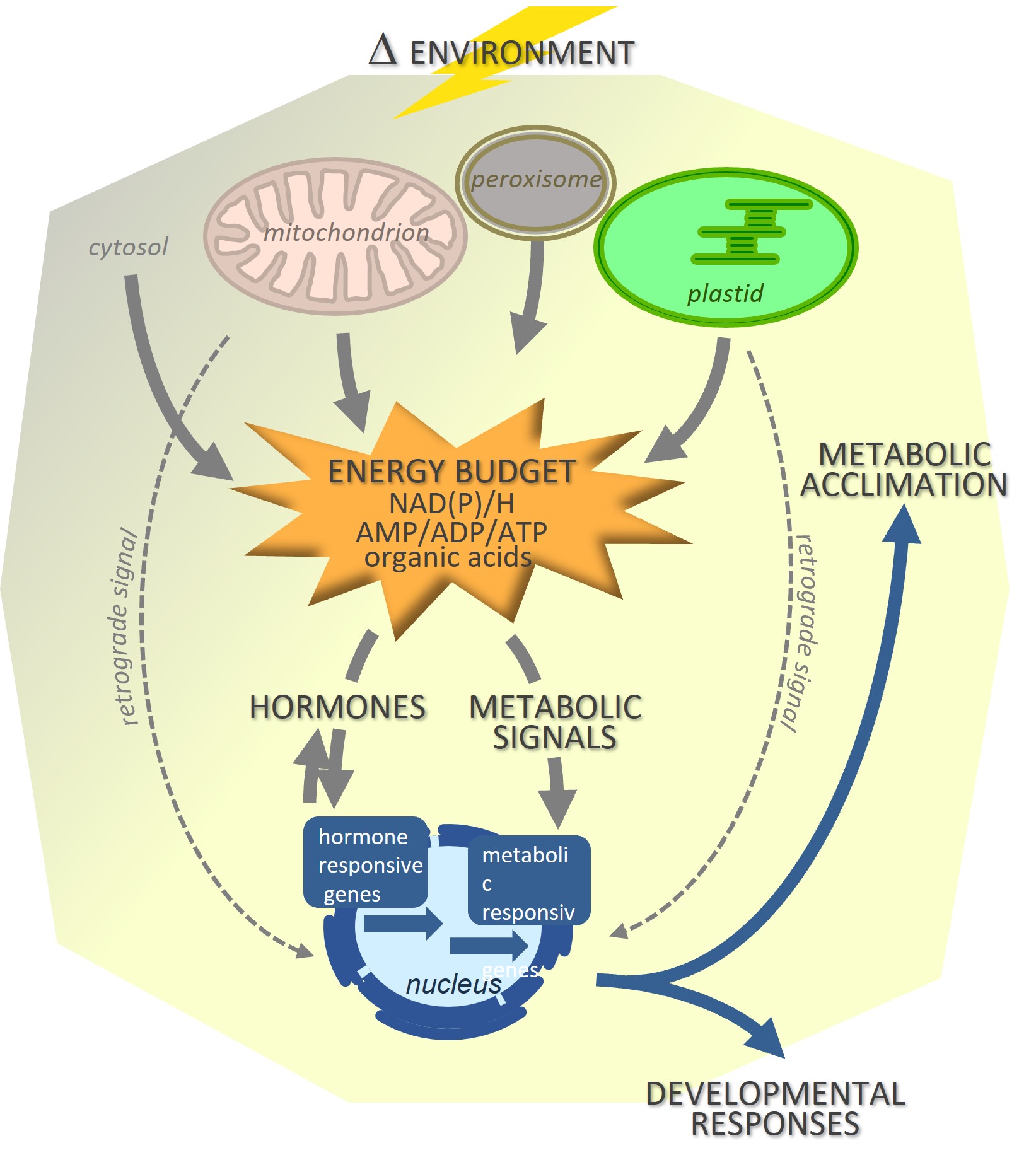
Energy metabolism, integrator of environmental stimuli allowing plant metabolic and developmental acclimation

Bertrand Gakière
Directeur scientifique de la plateforme Métabolisme Métabolome MC, UPSaclay