


Équipe SILAB / Florian Frugier
Présentation
Voies de signalisation régulant l’architecture du système racinaire des légumineuses en réponse à des bactéries bénéfiques
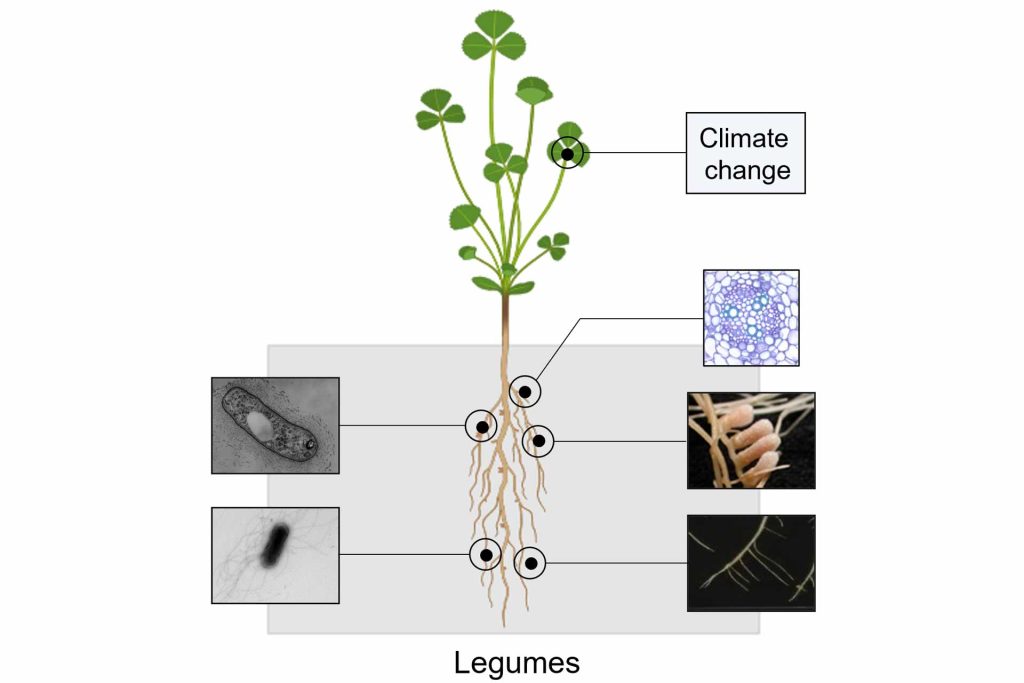
Le projet scientifique de l’équipe SiLAB porte sur les interactions entre le système racinaire des plantes et les bactéries bénéfiques du sol, notamment les rhizobiums fixateurs d’azote et les bactéries favorisant la croissance des plantes.
L’équipe cherche à comprendre comment les plantes régulent ces interactions en fonction de leurs besoins nutritionnels, en étudiant les mécanismes de signalisation qui agissent dans les racines et entre les racines et les parties aériennes.
Dans le contexte du changement climatique, SiLAB étudie également comment la nutrition et les bactéries bénéfiques influencent l’architecture racinaire, le développement des plantes et leurs réponses aux stress environnementaux.


Axel DE ZELICOURT,
Maitre de Conférence, Université Paris-Saclay


Camille FONOUNI-FARDE
Maitresse de Conférence, Université Paris-Saclay



Florian FRUGIER
Directeur de Recherche, CNRS – Responsable d'équipe




Bérengère DECOUARD
Post-Doctorante, Université Paris-Saclay

Carla ECHEVERRY-MEJIA
Doctorante, Université Paris-Saclay






Publications
Collaborations
Projets en cours
Projet ANR : Determinate « Evolution and function of symbiotic nodule determinacy in legume plants » (2026-2029). Partenaire: Jean-Malo Couzigou (LRSV-Toulouse).
Projet ANR : CLIPS « CEP, CLE, and IDA peptides at the crossroad of Parasitic and Symbiotic interactions » (2026-2029). Partenaire: Nicolas Frei-dit-Frey (LRSV-Toulouse).
Projet ANR : Insider « Understanding how symbiotic signals from rhizobium reprogram inner root tissues related to nutrition » (2025-2028). Partenaire : Sandra Bensmihen (LIPME, Toulouse).
Projet ANR : SymBase « Deciphering how symbiotic infection is triggered in lateral root base nodulated legumes » (2025-2028). Partenaires : Jean-François Arrighi (PHIM, Montpellier), Fernanda de Carvalho-Niebel (LIPME, Toulouse).
Projet ANR : OPTILEG « Optimization of microbial interactions for sustainable production of legume proteins, beneficial for the environment and health » (2024-2029). En collaboration avec 9 partenaires.
Projet ANR : CytoSYM « Understanding how a cytokinin signaling transcription factor can control both positively and negatively symbiotic nodulation » (2023-2027). Partenaire : M. Benhamed (IPS2, Gif-sur-Yvette).
Projets passés
+
Projet ANR : SymbiSIL «Legume–rhizobia siRNA-mediated communication in symbiosis » (2022-2026). Partenaires : C. Lelandais (IPS2, Gif-sur-Yvette, France), L. Navarro (IBENS, Paris).
Projet ANR : SYMPA-PEP «Symbiotic & pathogenic peptides at the interface between plants and microorganisms » (2021-2025). Partenaires : N. Frei dit Frey (LRSV, Toulouse), B. Favery (ISA, Sophia-Antipolis).
Projet ANR : PIOSYM « Understanding the mode of action of a pioneer transcription factor during symbiotic nodule development » (2020-2023). Partenaires : A. Niebel (LIPM, Toulouse), M. Crespi et M. Benhamed (IPS2, Gif-sur-Yvette).
Projet ANR : PSYCHE « Plant systemic responses to changing root environments » (2017-2021). Partenaires : M. Lepetit (LSTM, Montpellier), C. Jacquet (LRSV, Toulouse).
Projet collaboratif UE (H2020-SFS-2016-2017) : EUCLEG « Breeding forage and grain legumes to increase EU’s and China’s protein self-sufficiency » (2017-2021). Partenaires : 11 Instituts/Universités françaises et 5 chinoises.
Projet ANR : STAYPINK « Mechanisms controlling the transition between nitrogen fixation and senescence in legume symbiotic nodules » (2016-2020). Partenaires : C. Bruand (LIPM-Toulouse), P. Frendo (ISA, Sophia-Antipolis).
Projet ANR : NodCCAAT « Understanding the mode of action of the symbiosis-specific NF-YA1 transcription factor in Medicago truncatula » (2016-2019). Partenaires : A. Niebel (LIPM, Toulouse), M. Crespi et M. Benhamed (IPS2, Gif-sur-Yvette).
Projet collaboratif UE (FP7-KBBE-2011-5. KBBE.2011.1.1-02) : ABSTRESS « Improving the resistance of legume crops to combined abiotic and biotic stress » (2012-2017). Partenaires : FERA (The Food and Environment Research Agency, UK), ESSEX (The University of Essex, Royaume-Uni), ABER (The University of Aberystwyth, Royaume-Uni), INRA-Dijon (France), ABC (Agricultural Biotechnology Centre, Hongrie), CSIC-Cordoba (Espagne), GenXPro (Allemagne), Arterra Bioscience (Italie), PGRO (Processors and Growers Research Organization, Royaume-Uni), AGRO (Agrovegetal, Espagne), AGRITEC (République Tchèque).
Projet ANR-Blanc International (Hongrie/France) : LEGUMICS « Expanding the genomic tools for legumes and demonstrating their power in roots and symbiotic nodule development studies » (2011-2014). Partenaires : P. Kalo (ABC, Gödöllö, Hongrie), G. Endre (BRC, Szeged, Hongrie), A. Kereszt, (BAYGEN, Szeged, Hongrie), P. Ratet (ISV-CNRS, Gif-sur-Yvette).
Projet ANR-« Plant KBBE » (Allemagne/Espagne/France) : ROOT « Root enhancement for crop improvement » (2010-2013). Partenaires : T. Schmülling (FUB, Berlin, Allemagne), A. Leyva (CNB-CSIC, Madrid, Espagne), P. Nacry (BPMP-INRA, Montpellier), M. Crespi (ISV-CNRS, Gif-sur-Yvette), A. Walter (ICG, Berlin, Allemagne), J. Weyen (SURL, Leopoldshöhe, Allemagne).
Projet bilatéral CNR-CNRS Italie-France : « Role of KNAT transcription factors in root and nodule development » (2010-2014). Partenaires : G. Frugis (CNR, Rome, Italie).
Projet ANR-Jeune Chercheur : LEGUROOT « Cytokinin signaling and legume root architecture under symbiotic and non-symbiotic conditions » (2009-2012).
Projet ANR-OGM : DIAGNOGENE « Control of epigenetic inactivation of transgenes and diagnostic instability of gene expression » (2006-2010). Partenaires : H. Vaucheret (INRA, Versailles).
Projet ECOS-Sud : « Involvement of transcription factors in the regulation of salt stress responses in M. truncatula » (2007-2010). Partenaires : R. Chan (University of Santa Fe, Argentine).